Why 90% of Outreach Campaigns Fail (And How Smart Teams Fix Them)
Most outreach campaigns fail for the same five predictable reasons — wrong targeting, generic messaging, inconsistent follow-up, broken scaling, and zero visibility. This guide breaks down what's really killing your reply rates, backs it with real benchmarks and a launch checklist, and shows how smart teams turn outreach into a predictable, automated pipeline engine.
At 11:47 PM, Sarah was still staring at her CRM.
Three weeks. 612 LinkedIn connection requests. 41 replies. Zero meetings booked.
She'd followed every "best practice" she could find. She'd used a catchy opener. She'd personalized the first message with the prospect's name. She'd even paid for a "premium" lead list that promised verified emails and titles.
And still — nothing.
Sarah wasn't lazy. She wasn't bad at sales. She'd closed six-figure deals before. But that night, scrolling through a graveyard of unanswered messages, she finally admitted something most founders and sales leaders take months — sometimes years — to figure out.
The problem wasn't her offer.
It wasn't her pitch.
It wasn't even her LinkedIn profile.
The problem was her system — or more accurately, the complete absence of one.
What Sarah was running wasn't an outreach campaign. It was a series of disconnected, manual tasks held together by spreadsheets, sticky notes, and hope. And she's far from alone. Most teams running sales outreach campaigns today are doing the exact same thing — just with more polish.
Here's where things get interesting: after analyzing patterns across thousands of LinkedIn outreach campaigns — agencies, recruiters, SaaS founders, consultants — the reasons campaigns fail aren't mysterious. They're predictable. They show up in the same order, in nearly every company, regardless of industry.
And once you see them, you can't unsee them.
Let's walk through exactly what's killing your outreach campaign strategy, back it with real benchmarks, and show how smart teams are quietly fixing it.
Outreach Campaign Statistics That Matter
Before diving into the five core problems, it's worth grounding this in numbers. Most teams have no idea what "good" actually looks like, so they have no way of knowing whether their outreach campaigns are underperforming or right on track.
Here's a realistic benchmark snapshot based on patterns observed across LinkedIn outreach and B2B outbound sales automation campaigns:
| Metric | Poor Performance | Average Performance | Strong Performance |
|---|---|---|---|
| LinkedIn connection acceptance rate | Below 15% | 20–30% | 35–50% |
| Reply rate (first message) | Below 3% | 5–10% | 15–25% |
| Reply rate (full sequence, 3-5 touches) | Below 8% | 12–18% | 20–30% |
| Meeting booked rate (from replies) | Below 10% | 15–25% | 30–40% |
| Lead-to-opportunity conversion | Below 5% | 8–15% | 18–25% |
| Time spent on manual outreach admin (per rep/week) | 10+ hours | 5–8 hours | Under 3 hours |
These ranges aren't arbitrary — they reflect what separates outreach campaigns that generate predictable pipeline from outreach campaigns that generate busywork. If your numbers are sitting in the "poor" column, the issue almost certainly traces back to one (or more) of the five problems below, not a lack of effort.
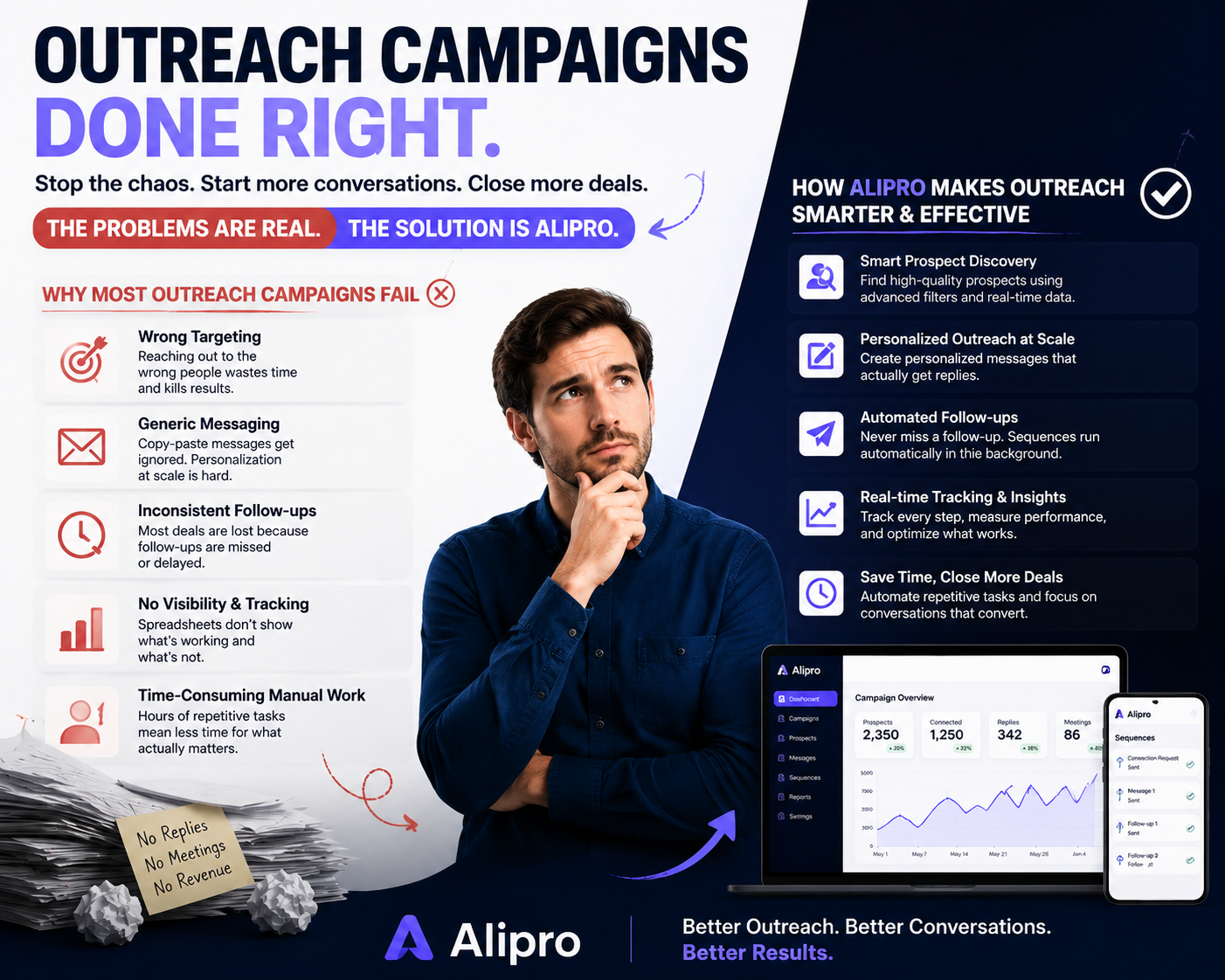
Problem #1: Targeting the Wrong Prospects
The Problem
Most outreach campaigns don't fail because of bad messaging. They fail before a single message is ever sent — at the targeting stage.
Here's the uncomfortable truth: if you're sending outreach to the wrong people, nothing else matters. Not your copywriting. Not your follow-up cadence. Not your offer. You could write the most compelling message in the world, and it still won't convert if it lands in the inbox of someone who has no authority, no budget, and no pain point you solve.
Why It Happens
This happens more than teams want to admit. A few common patterns:
- Generic prospect lists scraped from outdated databases, full of people who changed jobs two years ago
- "Spray and pray" targeting — going broad instead of narrow, hoping volume will compensate for relevance
- No segmentation between cold leads, warm leads, and people who've already engaged with your brand
- Job-title guessing instead of using firmographic and intent-based filters
The result? Outreach campaigns that look busy on paper — thousands of connection requests sent — but produce almost nothing in actual pipeline. Teams burn through LinkedIn's weekly invite limits chasing the wrong accounts, then wonder why their reply rate sits at 2-3%.
Best Practice
Effective sales prospecting starts with a tightly defined ideal customer profile, not a loosely defined "anyone who might buy." That means filtering by company size, industry, growth stage, hiring activity, technology stack, and — critically — recent buying signals like funding rounds, leadership changes, or job postings that hint at a current pain point.
The Modern Approach
Modern outreach campaign strategy treats targeting as a living, evolving process rather than a one-time list export. Intent signals (who's actively engaging with related content, who recently changed roles, who's hiring for a problem you solve) now matter more than static firmographic filters alone. This is part of a broader shift covered in most LinkedIn lead generation guides: precision beats volume, every time.
The Alipro Solution
This is exactly where Alipro's LinkedIn lead generation engine earns its place in the stack. Instead of relying on stale, purchased lists, teams use Alipro to build highly specific prospect segments based on role, industry, company size, activity, and engagement signals — functioning less like a simple scraper and more like a full LinkedIn lead generation platform built around targeting precision.
When your targeting is right, your reply rates, meeting rates, and pipeline quality improve almost immediately — often before you change a single word of your messaging.
Problem #2: Generic Messages Nobody Responds To
The Problem
But that wasn't the real problem for Sarah — even after she fixed her targeting, her reply rate barely moved.
Why? Because her messaging was a copy-paste template she found in a LinkedIn outreach "swipe file."
Why It Happens
Prospects can smell a template from a mile away. The "I noticed we're both in the same industry" opener. The "I'd love to pick your brain" line. The generic compliment about their "impressive background." These phrases have been used so many times that they've become outreach white noise — instantly ignored, instantly deleted.
The consequences of generic, copy-paste outreach are brutal:
- Response rates drop below 5%, sometimes below 1%
- Prospects mentally categorize your brand as "spam" before they've even understood your offer
- LinkedIn profiles get reported, restricted, or flagged for inauthentic activity
- Sales reps waste hours sending messages that produce nothing
This is where most companies make a critical mistake: they assume personalization means inserting a first name into a template. Real outreach personalization means referencing something specific and relevant — a recent post, a company milestone, a shared connection, an actual pain point tied to their role.
Best Practice
The strongest-performing sales outreach campaigns layer personalization in three places: the opening line (relevance), the body (a specific, credible value proposition), and the call to action (low-friction, easy to say yes to). Skipping any one of these collapses reply rates, even if the other two are strong.
The Modern Approach
The challenge is that doing this manually doesn't scale — no rep has time to research 200 prospects individually every week. This is exactly the gap that AI-assisted personalization is closing in 2026: systems that can pull in dynamic, relevant context automatically, without making messages feel mass-produced. (We go deeper on message structure in our outreach personalization guide.)
The Alipro Solution
Alipro's multi-step outreach sequences are designed to combine automation with genuine personalization — not one at the expense of the other. As a sales engagement and outreach automation platform, Alipro lets campaigns pull in dynamic fields, tailor messaging by segment, and structure sequences so each touchpoint feels like it was written for that specific person, not blasted to a list.
Instead of choosing between "scalable" and "personal," teams running campaigns through Alipro get both — automated outreach campaigns that still feel human.
Problem #3: Inconsistent Follow-Ups
The Problem
Keep reading, because the next issue is even more expensive than the first two combined.
Here's a statistic that should make every sales leader uncomfortable: the majority of meetings booked through outreach happen after the third, fourth, or fifth touchpoint — not the first. Yet most outreach campaigns stop after one or two attempts.
Why It Happens
Manual follow-up is exhausting, easy to forget, and nearly impossible to track consistently across dozens or hundreds of active conversations. A rep sends an initial message, gets distracted by other priorities, and the lead simply disappears — not because the prospect said no, but because nobody followed up.
- Leads forget about your message within 48–72 hours if there's no follow-up
- Manual follow-up sequences fall apart the moment a rep gets busy, sick, or distracted
- Spreadsheet-based tracking leads to duplicate messages, missed leads, or both
- Warm leads go cold simply because nobody closed the loop
Best Practice
Effective lead nurturing in outbound contexts isn't about sending more messages — it's about sending the right message at predictable intervals, spaced to stay relevant without becoming annoying. A common, well-performing cadence is touchpoints at day 1, day 4, day 9, and day 16, with each message adding new value rather than just "bumping" the thread.
The Modern Approach
The biggest mistake is still ahead for teams who think more outreach volume is the fix. It isn't. The fix is consistency — automated follow-up sequencing that doesn't depend on a rep's memory or bandwidth. This is the foundation of most modern follow-up strategy guides: automation isn't about removing the human touch, it's about protecting it from falling through the cracks.
The Alipro Solution
Alipro automates multi-step follow-up sequences so no lead falls through the cracks. Once a campaign is built, the platform — functioning as a full campaign management and lead nurturing system — handles the timing, sequencing, and delivery of follow-ups automatically, whether that's a second touchpoint after three days or a fifth touchpoint after three weeks.
Problem #4: Outreach Becomes Impossible to Scale
The Problem
And this is where most companies fail without even realizing it.
Let's say a team fixes targeting, messaging, and follow-ups. Results improve. Leadership gets excited. The natural next step is to scale — more reps, more campaigns, more volume.
This is exactly when everything breaks.
Why It Happens
The system that worked for one person sending 50 messages a week falls apart the moment five people are sending 50 messages a week each. Spreadsheets that tracked leads "well enough" become unmanageable.
- Lead data lives in five different spreadsheets, none of which match
- Reps accidentally message the same prospect from different accounts
- There's no single source of truth for campaign performance
- Onboarding a new rep takes weeks because there's no repeatable process
- Manual data entry eats hours that should be spent on actual selling
Best Practice
Scalable outbound sales automation requires a centralized system of record before headcount grows — not after. Teams that scale outreach successfully standardize their sequences, targeting criteria, and reporting structure before adding a second or third rep, so growth multiplies results instead of multiplying chaos.
The Modern Approach
This is a core theme in most campaign management guides published in the last two years: the shift from individual outreach "hustle" to a shared outreach operating system that any rep can plug into and immediately follow.
The Alipro Solution
Alipro is built for campaign management at scale. Instead of spreadsheets and disconnected tools, every campaign, sequence, and lead lives in one centralized system. As a sales workflow platform, Alipro allows teams to launch outreach automation across multiple accounts or seats without losing visibility or duplicating effort — turning outreach into an outbound growth engine rather than a fragile manual process.
Problem #5: Teams Lose Visibility and Control
The Problem
What happened next surprised everyone — including leadership.
After scaling outreach across a growing team, one sales leader realized something alarming: nobody could actually answer simple questions like "How many leads are in active sequences right now?" or "Which campaign is performing best this month?"
Why It Happens
The team was using four different tools — one for lead lists, one for LinkedIn automation, one for follow-up reminders, and a CRM that only got updated "when someone remembered."
- No centralized reporting on campaign performance
- No clear visibility into which messages or sequences actually convert
- Account safety risks from using disconnected or risky automation tools
- Leadership making decisions based on guesses, not data
- Reps working in silos with zero shared learning
Best Practice
You can't improve what you can't measure. The strongest-performing teams review campaign-level data weekly — not just reply counts, but acceptance rates, sequence drop-off points, and meeting conversion by segment — to continuously refine targeting and messaging.
The Modern Approach
In 2026, sales engagement platforms are converging on a single principle: outreach software should function as a control center, not a messaging tool bolted onto a spreadsheet.
The Alipro Solution
Alipro centralizes outreach management into a single dashboard — campaigns, leads, sequences, and performance data all in one place. Teams get real visibility into what's working, supported by built-in LinkedIn account safety controls that protect against the platform restrictions and flags that come from careless automation. This is what separates a true campaign management system from a basic LinkedIn automation tool.
7 Outreach Campaign Metrics Every Team Should Track
Most teams track one number — replies — and ignore the rest. That's like judging a restaurant only by how many people walk through the door, without asking how many actually order food. Here are the seven metrics that matter most:
| # | Metric | What It Tells You | Healthy Benchmark |
|---|---|---|---|
| 1 | Connection acceptance rate | Whether your targeting and profile positioning are credible | 25–40% |
| 2 | Reply rate (per message) | Whether your messaging resonates with that specific segment | 10–20% |
| 3 | Sequence completion rate | Whether your follow-up cadence is well-paced | 70%+ |
| 4 | Meeting booked rate | Whether your CTA and offer are compelling enough to act on | 20–30% of replies |
| 5 | Lead-to-opportunity rate | Whether your targeting is actually qualified, not just responsive | 10–20% |
| 6 | Time-to-first-response | How quickly prospects engage once contacted | Under 48 hours |
| 7 | Account health / restriction rate | Whether your LinkedIn automation is safe and sustainable | Zero flags/restrictions |
Tracking these seven consistently — by campaign, by segment, by message variant — is what turns outreach from guesswork into a repeatable outreach campaign strategy.
Common Outreach Campaign Mistakes
After reviewing patterns across hundreds of LinkedIn outreach and sales outreach campaigns, the same mistakes resurface again and again:
- Treating LinkedIn outreach like cold email — different platform, different etiquette, different expectations
- Sending the same message to every segment instead of tailoring by role or industry
- Ignoring connection acceptance rate as an early warning signal
- Stopping after one or two follow-ups instead of running a full sequence
- Using vague CTAs like "let's connect" instead of a specific, low-friction ask
- Over-automating to the point messages feel robotic and identical
- Under-automating and burning out reps with manual, repetitive tasks
- No clear ICP, leading to wasted sends on unqualified prospects
- Ignoring LinkedIn's sending limits and safety thresholds, risking account restrictions
- No centralized tracking, leading to duplicate outreach and lost leads
- Never testing message variants, so underperforming copy runs for months unnoticed
- Treating outreach as a one-time project instead of an ongoing, optimized system
If even three or four of these sound familiar, it's a strong sign the issue isn't effort — it's structure.
Outreach Campaign Checklist Before Launch
Before launching any new sales outreach campaign, run through this list:
Targeting
- [ ] ICP clearly defined (industry, size, role, signals)
- [ ] Prospect list verified and de-duplicated against past campaigns
- [ ] Segments split by relevant differentiators (industry, seniority, use case)
Messaging
- [ ] Opening line is specific, not generic
- [ ] Value proposition tailored to the segment
- [ ] CTA is low-friction and specific (not "let's connect")
- [ ] Sequence has at least 3-5 touchpoints planned
Automation & Safety
- [ ] Sending volume within safe LinkedIn limits
- [ ] Follow-up timing scheduled (not manual/memory-based)
- [ ] Account safety controls active
Tracking
- [ ] Campaign-level reporting set up before launch
- [ ] Clear owner assigned to review performance weekly
- [ ] Benchmarks set in advance to judge performance
Skipping any one of these sections is usually where outreach campaigns quietly start failing — long before anyone notices the dip in replies.
Why Most LinkedIn Automation Tools Fail
It's worth pausing here to educate rather than sell, because this is a question worth answering honestly: if automation is so useful, why do so many LinkedIn automation tools get a bad reputation?
A few recurring reasons:
- They optimize for volume, not safety — pushing send limits aggressively until accounts get restricted
- They automate sending but not strategy — leaving targeting and messaging exactly as bad as they were, just faster
- They lack centralized reporting, so teams can't tell what's actually working
- They treat every campaign the same, with no segmentation or sequence logic
- They're built as point solutions, not full campaign management systems — meaning teams still need spreadsheets, CRMs, and manual follow-up trackers on the side
The lesson here isn't "automation is risky." It's that automation without strategy, safety controls, and centralized visibility just makes existing mistakes happen faster. This is precisely why outreach software needs to be evaluated as a system — targeting, messaging, sequencing, safety, and reporting together — not as a single send-button replacement.
The Compound Cost of Broken Outreach Campaigns
Here's the part most companies never calculate: broken outreach doesn't just cost you a few missed leads. It compounds.
Every wrongly-targeted prospect is wasted time. Every generic message is a damaged first impression that can't be undone. Every missed follow-up is a deal that quietly dies. Every hour spent manually tracking leads in spreadsheets is an hour not spent talking to prospects who are actually ready to buy.
Add it up over a quarter, and the numbers get painful:
- A rep spending 10+ hours a week on manual prospecting and tracking is losing roughly 25% of their working time to admin instead of selling
- A campaign with a 2% reply rate instead of a realistic 15-20% rate is leaving 7-10x the pipeline on the table
- A lead that goes cold from a missed follow-up isn't just one lost deal — it's the referrals, renewals, and expansion revenue that deal could have generated
This is the real cost of broken outreach campaigns: not a single bad month, but a slow, compounding leak in revenue that's easy to ignore because it never shows up as one big, obvious failure. It just shows up as "pipeline feels thin" — quarter after quarter.
Outreach Campaigns in 2026
Outreach hasn't just gotten more automated — it's gotten smarter, and the gap between teams using modern tools and teams still operating manually is widening fast.
A few shifts defining outreach campaigns in 2026:
- AI personalization has moved beyond merge fields — modern systems can reference real context (recent posts, company news, role changes) at scale, without making outreach feel mass-produced
- Intent signals now drive targeting more than static firmographics — who's hiring, who's engaging with relevant content, who recently raised funding
- Automated follow-ups are expected, not optional — manual-only follow-up is quickly becoming a competitive disadvantage
- Centralized campaign management has replaced the old stack of disconnected point tools, consolidating targeting, messaging, sequencing, and reporting
- Modern sales workflows blend outbound and inbound signals, so outreach increasingly happens after a prospect shows some form of engagement, not cold
Teams still running 2021-era outreach playbooks — generic templates, manual tracking, single-touch follow-up — aren't just underperforming. They're actively losing ground to competitors who've already made this shift.
How Modern Teams Build Outreach Engines Instead of Outreach Tasks
The teams that consistently win at outreach have made one fundamental shift: they stopped treating outreach as a series of tasks and started treating it as a system.
A task-based approach looks like this: send messages, hope for replies, manually follow up when you remember, track results in a spreadsheet if there's time.
A systems-based approach — an outreach engine — looks completely different:
- Automation handles the repetitive sending and sequencing, freeing up human time for actual selling
- Personalization is built into the system itself, not bolted on as an afterthought
- Follow-ups happen automatically and consistently, regardless of how busy the team is
- Lead management is centralized, so every prospect's status is visible at a glance
- Campaign visibility gives leadership real data instead of guesses
This is exactly the gap Alipro was built to close. It functions less like a single-purpose LinkedIn automation tool and more like a full outbound growth engine — combining LinkedIn lead generation, outreach automation, campaign management, sales workflow coordination, and lead nurturing into one connected sales engagement platform.
Founders, agencies, recruiters, consultants, and B2B sales teams use Alipro precisely because it replaces five disconnected habits with one connected system — and that shift alone is often the difference between outreach that generates real pipeline and outreach that just generates busywork.
Realistic Example: From Manual Chaos to Predictable Pipeline
Consider a small B2B agency — three founders, no dedicated SDR team, trying to book their own sales meetings while running client work.
Before Alipro:
- Sending LinkedIn connection requests manually, roughly 80-100 per week across three accounts
- Using a generic template with the prospect's first name swapped in
- Following up "when they remembered" — which often meant never
- Tracking leads in a shared spreadsheet that was perpetually out of date
- Reply rate: around 4%
- Meetings booked per month: 3-5
- Hours spent on outreach admin per week: roughly 12
After Alipro:
- Built targeted lead segments based on industry, company size, and recent hiring activity
- Launched automated, multi-step outreach sequences with messaging tailored by segment
- Follow-ups triggered automatically at 3, 7, and 14 days
- All leads and campaign performance tracked in one centralized dashboard
- Reply rate: 18-22%
- Meetings booked per month: 22-28
- Hours spent on outreach admin per week: roughly 3
The founders didn't work harder. They didn't hire more reps. They didn't even change their core offer. They changed the system underneath their outreach — and the results followed naturally.
Real SaaS Founder Case Study: Targeting YC Startups
A solo SaaS founder building a developer tools product set an ambitious goal: book 15 demo calls a month exclusively with YC-backed startups, a notoriously fast-moving, low-patience audience that ignores anything that smells like a templated pitch.
Before:
- Manually researching each YC company from the public directory, then messaging founders one by one
- Using the same opening line for every company, regardless of batch, sector, or stage
- Reply rate: 3%
- Demo calls booked per month: 2
- Time invested per week: roughly 15 hours, almost entirely on research and manual sends
What Changed:
The founder rebuilt the campaign around segmentation instead of brute force — splitting YC companies by batch, sector (fintech, devtools, infra), and recent signals like new funding announcements or job postings indicating they were scaling engineering. Messaging was tailored per segment instead of one generic pitch for "all YC founders."
Follow-up sequences were automated at day 2, day 6, and day 12, each adding new value — a relevant case study, a specific integration angle, a direct, low-friction CTA — rather than simply repeating the ask.
After Alipro:
- Reply rate: 21%
- Demo calls booked per month: 17
- Time invested per week: roughly 4 hours, mostly spent actually running demo calls instead of researching prospects
Lessons Learned:
- Segmentation beat personalization-by-name every time — batch and sector mattered more than the prospect's first name
- Founders respond better to specificity ("we integrate with X") than flattery ("love what you're building")
- Automating follow-up timing, not just the first message, was responsible for the majority of the lift in booked calls
- The biggest unlock wasn't a clever message — it was finally having a system that didn't depend on the founder remembering to follow up
Conclusion: The Outreach Campaigns That Win Aren't the Ones That Try Harder
Sarah's story — and the agency's story, and the YC founder's story, and the thousands of similar stories playing out across LinkedIn every single day — all point to the same conclusion.
Outreach campaigns don't fail because people aren't trying hard enough. They fail because most teams are running manual tasks and calling them a strategy. Wrong targeting. Generic messaging. Inconsistent follow-up. Tools that don't scale. Zero visibility into what's actually working.
Every day you delay fixing your outreach process is another day your competitors are filling their pipelines while yours stays empty.
The question isn't whether outreach works. Outreach has always worked — when it's built as a real system instead of a collection of good intentions, backed by the kind of benchmarks, structure, and centralized visibility outlined above.
The question is whether your outreach campaign strategy is built to win, or built to break the moment you try to scale it.
If you're ready to stop chasing prospects manually and start building a predictable, automated outreach engine — one with the LinkedIn lead generation precision, personalization, follow-up consistency, and campaign visibility your team has been missing — Alipro can help you build it.
Content Team
The ALipro team writes about LinkedIn outreach, B2B sales automation, and lead generation strategies for modern sales teams.