10 LinkedIn Message Templates That Convert at Every Stage of the Sales Funnel
10 copy-paste LinkedIn message templates mapped to every sales funnel stage — from cold connection requests to follow-ups, social proof, and closing — plus a framework for writing your own.
Consider a SaaS founder who sends 300+ LinkedIn messages in a single campaign.
He gets a handful of replies, and maybe one turns into a sales call — a reply rate well under 3%.
The problem wasn't LinkedIn, and it wasn't volume. Every prospect got the same message, regardless of whether they'd just accepted a connection request or were already evaluating vendors. It's a pattern we see constantly: when outreach gets rebuilt around funnel stage instead — a no-pitch opener for new connections, a value-led follow-up for warm leads, a direct ask reserved for prospects who've already engaged — reply rates and meeting quality both improve, often substantially.
That's the pattern this article is built around. The same principles apply whether you're running LinkedIn cold outreach, nurturing warm prospects, or following up after a demo. Below are 10 LinkedIn message templates, a proprietary framework for writing your own (RISE), a decision table for picking the right one fast, a recommended send sequence, the most common LinkedIn outreach mistakes to avoid, and an FAQ covering the questions people actually search before sending a single message.
What We See Across Thousands of Outreach Interactions
Across the LinkedIn sales messages and follow-up sequences run through Alipro, a few patterns show up consistently regardless of industry:
- Personalized first-touch messages outperform generic pitches. Even light personalization — a name, a company, a specific detail — outperforms a templated blast.
- Social proof works best after some engagement already exists. A result-driven message lands far better on the third touch than the first.
- Shorter messages generally generate more replies. First messages under 3–4 sentences get read in full; longer ones get skimmed or skipped.
- Follow-ups carry the conversation. A large share of total replies across any outreach sequence come from the second or third message, not the first.
None of this is unique to any one platform — multiple sales outreach studies and the patterns visible across LinkedIn lead generation campaigns broadly agree on this. What changes is execution: matching the message to the funnel stage, consistently, at scale.
Common LinkedIn Outreach Mistakes
Most LinkedIn prospecting messages fail for a small, repeatable set of reasons:
- Pitching too early. Leading a connection request or first message with an offer reads as presumptuous, and acceptance rates drop accordingly.
- Sending walls of text. Long first-touch messages get skimmed, not read.
- No personalization. A message with no reference to the person's role, company, or recent activity is mass outreach wearing a first name.
- No follow-ups. Most replies to LinkedIn connection requests and cold outreach messages come from a follow-up, not the original send.
- Too many follow-ups. The opposite failure mode: more than 5–6 touches without a reply usually means it's time to stop, not escalate.
- Generic social proof. "We help companies grow" convinces no one. A specific, comparable result does.
Each template below is built to avoid these failure points by design.
Why Funnel-Stage Messaging Matters
A prospect who just viewed your profile isn't ready for a pitch. A prospect who's engaged with your content, replied to a previous message, or asked a follow-up question is in a different conversation entirely.
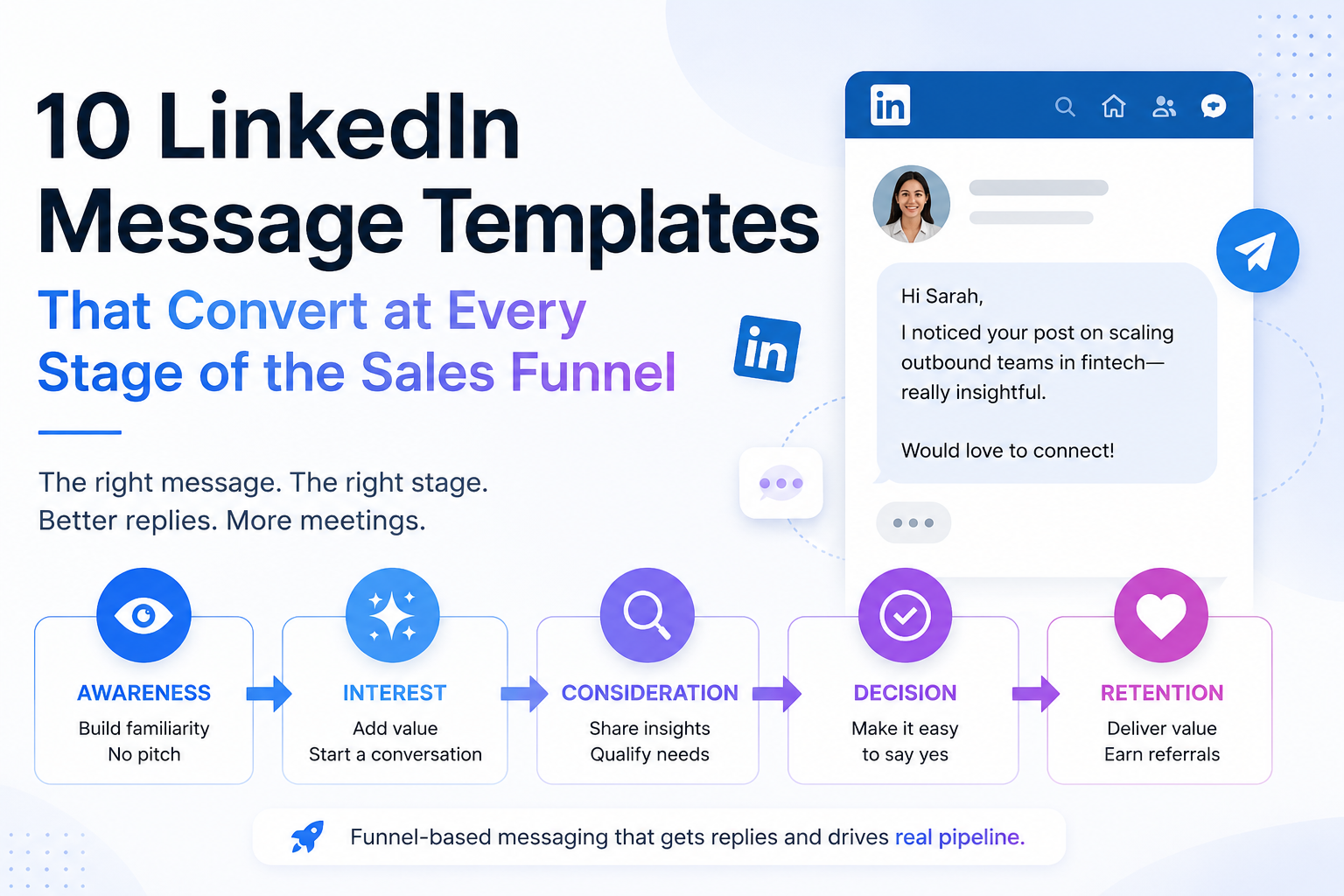
Awareness → Interest → Consideration → Decision → Retention
In Alipro, funnel stages can be assigned automatically through campaign logic. When a prospect replies, books a meeting, or engages with a piece of content, Alipro moves them into the next stage and triggers the appropriate message sequence — without a rep manually deciding what to send next.
The RISE Framework
Every high-performing LinkedIn message — cold outreach, follow-up, or retention — tends to hit four elements:
R — Relevance. A specific, real reason you're reaching out to this person. I — Insight. Something useful, not promotional. S — Social Proof. Evidence this works for people like them. E — Easy Next Step. One clear, low-friction ask.
Every template below includes a RISE breakdown.
Which Template Should You Use?
| Situation | Template |
|---|---|
| New connection, no history | #1 — Connection Request |
| Just accepted your connection | #2 — Value-First Opener |
| Hasn't responded yet, low-pressure check-in | #3 — Soft Discovery |
| Warm lead, needs a reason to act | #4 — Social Proof Nudge |
| Engaged with your content publicly | #5 — Content Follow-Up |
| Already had a conversation, ready to talk | #6 — Direct Meeting Ask |
| Went quiet after interest | #7 — Objection Handler |
| Time-sensitive offer applies | #8 — Urgency/Offer |
| Existing customer, early in their journey | #9 — Check-In |
| Existing customer, getting strong results | #10 — Referral/Testimonial Ask |
Top of Funnel: Awareness Stage Templates
1. The Connection Request (No Pitch)
Hi {{firstName}}, I came across your profile while researching {{industry/topic}} and really liked your take on {{specific post or detail}}. Would love to connect and follow your insights.
Real example:
Hi Sarah, I noticed your post on scaling outbound teams in fintech — the point about quality over volume really matched what I'm seeing in the market. Would love to connect.
RISE breakdown: Relevance (specific post reference) ✅ Insight (implied shared perspective) ✅ Social Proof — intentionally absent ❌ Easy Next Step — connect only ✅.
2. The Value-First Opener
Hi {{firstName}}, thanks for connecting! I just published a short piece on {{relevant topic}} that a few people in {{their industry}} have found useful — happy to send it over if it's relevant to what you're working on.
Real example:
Hi Sarah, thanks for connecting! I put together a short breakdown on UK outbound benchmarks for fintech teams — happy to send it if useful.
RISE breakdown: Relevance ✅ Insight (the content itself) ✅ Social Proof (light) ✅ Easy Next Step (opt-in offer, not a meeting ask) ✅.
This first-touch sequence is exactly the kind Alipro automates after a connection is accepted — rotating in unique personalization variables for every prospect.
Middle of Funnel: Interest & Consideration Templates
3. The Soft Discovery Message
Hi {{firstName}}, curious how your team currently handles {{pain point}}? I work with a lot of {{job title/industry}} folks tackling this and would love to hear your take.
Real example:
Hi Sarah, curious how your team is currently handling outbound now that you've expanded into the UK? I talk to a lot of sales leaders navigating that same transition.
RISE breakdown: Relevance (references their current process) ✅ Insight (your stated perspective) ✅ Social Proof (implied, light) ✅ Easy Next Step (just a question to answer) ✅.
4. The Social Proof Nudge
Hi {{firstName}}, we recently helped a team similar to yours at {{similar company/industry}} reduce {{specific metric}} by {{result}}. Thought it might be relevant given what you're doing at {{their company}} — worth a quick chat?
Real example:
Hi Sarah, we recently helped a fintech team of similar size cut their outbound response time by half. Thought it might be relevant given your UK expansion — worth a quick chat?
RISE breakdown: Relevance ✅ Insight (the result itself) ✅ Social Proof (the strongest signal of any template here) ✅ Easy Next Step (low-pressure ask) ✅.
Social proof performs best after some engagement already exists — a reply, a profile view, a content interaction — rather than in a true cold first message.
5. The Content Follow-Up
Hi {{firstName}}, I noticed you engaged with our recent post on {{topic}} — what stood out to you most? Happy to share more detail on how teams are applying it.
Anchor this to something public and visible — a LinkedIn comment, like, or share — rather than private analytics the prospect wouldn't expect you to have.
Bottom of Funnel: Decision Stage Templates
6. The Direct Meeting Ask
Hi {{firstName}}, based on our conversation, it sounds like {{solution}} could help with {{specific goal}}. Do you have 15 minutes this week or next to walk through how it would work for {{their company}}?
Real example:
Hi Sarah, based on what you mentioned about your UK rollout, it sounds like a centralized outbound system could help. Do you have 15 minutes this week or next to walk through how it'd work for your team?
RISE breakdown: Relevance (built on prior conversation) ✅ Insight (already established earlier in the thread) ✅ Social Proof (not needed — trust already exists) ✅ Easy Next Step (specific time window, specific ask) ✅.
7. The Objection Handler
Hi {{firstName}}, totally understand if timing isn't right. Out of curiosity, is it more about budget, priorities, or something else? Want to make sure I'm not following up at the wrong moment.
8. The Urgency/Offer Message
Hi {{firstName}}, we're closing out {{offer/cohort/pricing}} by {{date}} — wanted to flag it in case it's still useful for {{their goal}}. Want me to hold a spot?
The deadline needs to be real. A fabricated urgency message is one of the fastest ways to damage trust and get reported.
Retention & Advocacy Stage Templates
9. The Check-In Message
Hi {{firstName}}, it's been a few weeks since we started working together — how's everything going with {{product/feature}}? Anything I can help unblock?
Real example:
Hi Sarah, it's been about 30 days since your team started using the platform. Curious what's working best so far, and whether anything's slowing adoption internally?
RISE breakdown: Relevance (specific timeframe, real product context) ✅ Insight (offers to unblock, not just check a box) ✅ Social Proof (not needed at this stage — trust exists) ✅ Easy Next Step (an easy, specific question) ✅.
10. The Referral/Testimonial Ask
Hi {{firstName}}, glad to hear things are going well with {{result}}! If you know anyone else in {{industry}} who might benefit from something similar, I'd really appreciate an introduction — and happy to return the favor.
Real example:
Hi Sarah, glad to hear the UK team's adoption is picking up! If you know anyone else in fintech tackling similar outbound challenges, I'd really appreciate an introduction — happy to return the favor.
RISE breakdown: Relevance (their actual result) ✅ Insight (framed as mutual benefit) ✅ Social Proof (their own success, used as the proof point) ✅ Easy Next Step (a specific, narrow ask — not "let me know if you know anyone") ✅.
A Recommended Outreach Sequence
| Day | Template | Stage |
|---|---|---|
| Day 1 | #1 — Connection Request | Awareness |
| Day 3 | #2 — Value-First Opener | Awareness |
| Day 7 | #3 — Soft Discovery | Interest |
| Day 12 | #4 — Social Proof Nudge | Consideration |
| Day 18 | #6 — Direct Meeting Ask | Decision |
Spacing matters: 3–5 days between touches keeps you visible without becoming spammy, and most replies to a sequence like this land on the second or third message, not the first. In Alipro, this entire sequence is built once and triggers automatically as each lead's stage updates.
FAQ: LinkedIn Outreach Messaging
What is a good LinkedIn reply rate? Reply rates vary by industry and personalization quality, but well-personalized, funnel-matched messages consistently outperform generic mass outreach by a wide margin. Track your own baseline by template rather than chasing an industry-wide average.
Should I pitch in a LinkedIn connection request? Generally, no. Connection requests with no pitch tend to get accepted more often than those leading with an offer or CTA. Save the ask for after the connection is established.
How many follow-ups should I send on LinkedIn? Most replies come after the second or third touch, not the first. A sequence of 4–5 messages spaced several days apart, matched to funnel stage, is a reasonable default.
How long should I wait before following up? 3–5 days is typical. Faster follow-ups can feel pushy; slower ones lose momentum and context.
What is the best LinkedIn message length? Shorter, in most cases. First-touch messages under 3–4 sentences tend to get read in full; longer messages are more often skimmed or ignored entirely.
What should I do if a prospect doesn't respond? Send 2–3 more touches at increasing intervals, each adding new value rather than just "checking in" again. After 5–6 unanswered messages, it's usually time to pause that lead rather than escalate.
Is LinkedIn automation safe? Used responsibly, automation can help teams manage follow-ups and outreach workflows more efficiently. Always follow LinkedIn's terms of service and platform policies when automating any account activity.
Can LinkedIn outreach be automated? Yes. Platforms like Alipro can automate connection requests, sequenced follow-up messages, and stage-based tagging, while still allowing per-prospect personalization variables.
What are the best LinkedIn message templates for cold outreach? Start with a connection request that contains no pitch, follow with a value-first message, then move into discovery questions. Cold outreach performs best when trust is built gradually rather than forcing a sales conversation immediately.
The Takeaway
Go back to the founder sending 300+ messages for a handful of replies. The fix wasn't a better single message — it was matching the message to the stage the prospect was actually in.
If you're still sending the same LinkedIn message to every prospect, start with the sequence above and track your reply rates by template. Or let Alipro automate the entire process — from connection request to final follow-up — while keeping every message personalized and stage-specific.
Content Team
The ALipro team writes about LinkedIn outreach, B2B sales automation, and lead generation strategies for modern sales teams.